Your Guide to the NDIS Pricing Arrangements and Price Limits for 2025–26
A simple and supportive guide to help you understand the NDIS Price Guide, how it works, and how it can help you make the most of your funding.

Every year, around 1 July, the National Disability Insurance Scheme (NDIS) releases an updated document called the NDIS Pricing Arrangements and Price Limits (formerly the Price Guide). While it may sound technical, it plays an important role in how your supports are delivered — and how your NDIS funding is used.
At Isle of Hope, we understand that these updates can sometimes feel overwhelming. That’s why we’ve created this simple guide to help you understand what’s changed, what to look out for, and how to make the most of your plan in 2025–26.
What is the NDIS Pricing Arrangements and Price Limits?
This document outlines how much NDIS service providers can charge for different supports. It helps ensure consistency, fairness, and transparency across the sector — and protects participants like you from being overcharged.
It also gives providers the guidance they need to invoice correctly, while helping participants understand how their funding can be used. It includes:
General rules for pricing and claims
Support categories and line items
Maximum hourly rates for different types of support
Rules for travel, cancellations, and group supports
Another useful document released alongside it is the NDIS Support Catalogue, which lists every approved support item, its price limit, and claim types — including travel and non-face-to-face services.
Key Terms to Know
Before diving in, here are a few important terms that will help you understand how your plan is structured:
Support Purposes
NDIS supports fall into three key areas:
Core Supports
This is the most flexible part of your budget. It covers everyday needs like personal care, transport, assistance around the house, and participation in the community.
Capacity Building Supports
This budget is focused on helping you develop skills and increase your independence. It includes therapies, social skills training, employment support, and more.
Capital Supports
This is for one-off or larger purchases such as assistive technology or home modifications. It is less flexible and can only be used for its intended purpose.
Understanding the NDIS Outcomes Framework
The NDIS Outcomes Framework is a way to measure how the NDIS is helping people improve in different areas of their life. It breaks life goals into eight domains:
Daily living
Home
Health and wellbeing
Lifelong learning
Work
Social and community participation
Relationships
Choice and control
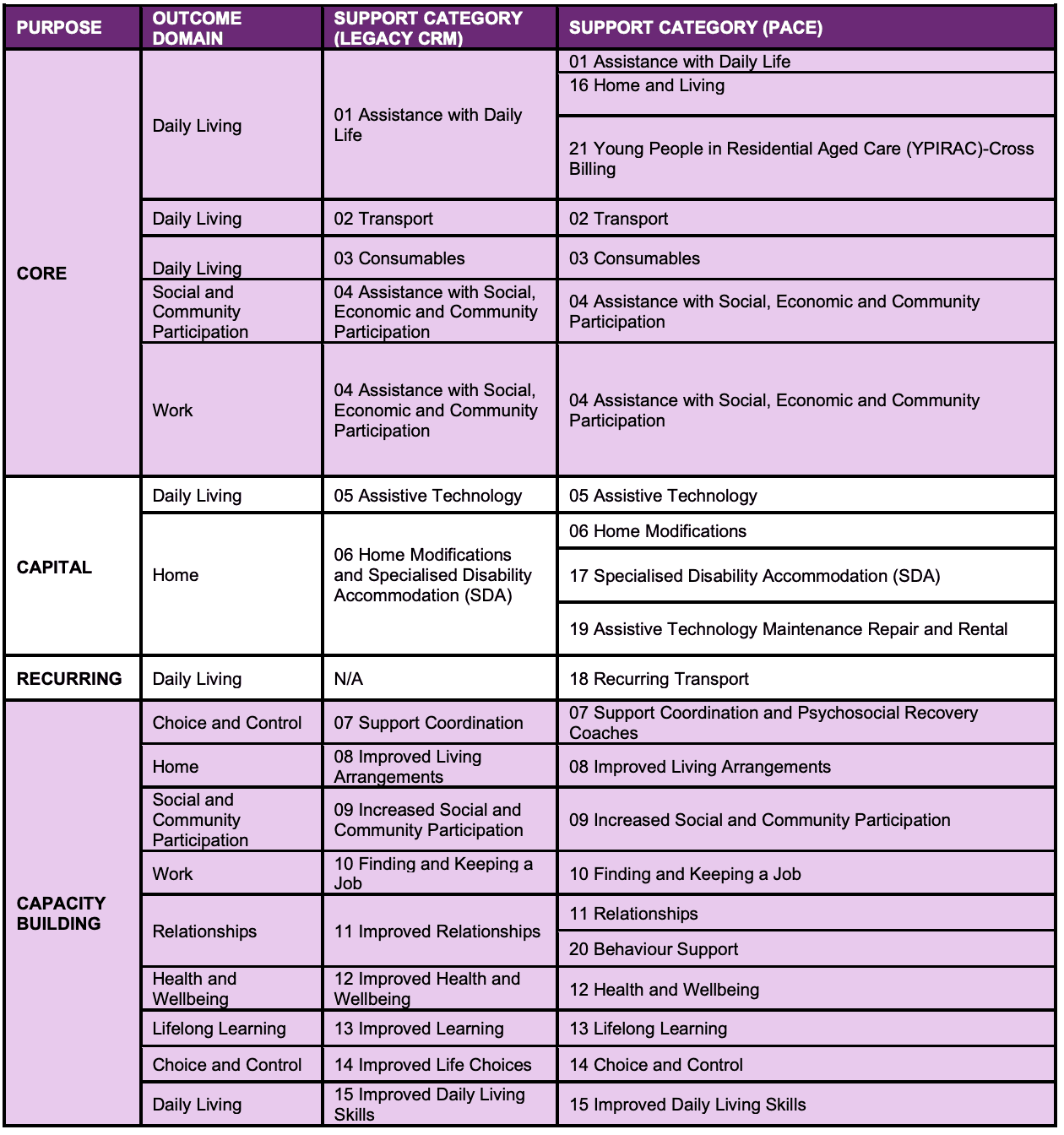
Each support category is aligned with one of these areas, which helps ensure your funding supports your personal goals — not just services.
Support Categories: What’s Changed?
Previously, the NDIS had 15 support categories. With the rollout of the new PACE system, that has expanded to 22 categories, offering more specific ways to align your supports with your outcomes.
This expanded structure makes it easier to match your funding to what you want to achieve, whether that’s joining a local class, improving mobility, or getting job-ready.
Support Items and Line Codes
Within each support category, there are individual support items. Each item has a code used for claiming services through the NDIS portal. These line items tell your provider — and your plan manager — exactly where the funding should come from.
For example, a support like “Community Access – Weekday” might have one line item, while “Group Therapy – Regional Area” would have another. The Pricing Arrangements document lists these line items, their price limits, and when they apply.
Price Limits Explained
Not all supports have fixed prices, but many do. A price limit is the maximum a provider can charge for a specific support.
The price might vary based on:
Location (metro, regional, or remote)
Day of the week (weekday, weekend, or public holiday)
Time of day
Type of support (e.g. standard vs. high intensity)
For example, assistance with personal care may have a higher price limit on Sundays due to increased wages for support workers. These price limits help you plan better and ensure your budget can stretch across the services you need.
Highlights from the 2025–26 Update
This year’s pricing update brought a few important changes:
Therapies like physiotherapy and psychology now have consistent prices nationwide, instead of being different for each state or territory.
Rates for some allied health supports have been adjusted based on actual delivery costs — with decreases in some therapies and increases in others.
The age limit for the early childhood approach has increased from 7 to 9, allowing more children to benefit from tailored support.
The NDIA has committed to releasing pricing reviews earlier in future, giving both participants and providers more time to prepare.
If you’re an NDIS participant, you don’t need to take any action. Your plan budget will be automatically adjusted to reflect these updates. But it’s still a good idea to check whether your providers have changed their rates — and ensure you’re still getting the best value for your supports.
No Matter How Your Plan Is Managed, the Price Guide Applies
Whether your plan is:
NDIA-managed (agency-managed),
Plan-managed, or
Self-managed,
The price limits still apply. Here's how:
Plan-managed: Your plan manager (like Isle of Hope) handles invoices and makes sure your providers charge within the correct limits. You don’t have to worry about the admin — we do it for you.
NDIA-managed: Providers are paid directly by the NDIA, and they must also stay within the set pricing caps.
Self-managed: You pay providers yourself. You can negotiate prices, but it’s important to be aware that NDIS will only reimburse up to the set limits.
Making the Most of Your Funding with Isle of Hope
As a registered NDIS provider, Isle of Hope offers a range of supports that may be available under several budget categories. Here’s how we help you get the best from your plan:
Core Supports – Assistance with Daily Life
We can support you at home with personal care, meal prep, cleaning, or daily routines — all while helping you feel comfortable and confident.
Core Supports – Community Participation
Whether it's a trip to the park, visiting friends, or attending a local group, we’ll support you to engage with your community in a way that feels meaningful to you.
Capacity Building – Increased Community Participation
We’ll work with you to build confidence and independence through new skills, such as using public transport or trying a new activity.
Capacity Building – Improved Daily Living
Our team can help you learn everyday tasks like cooking, budgeting, or household organisation to support greater independence.
Capacity Building – Health and Wellbeing
Looking to build a healthier lifestyle? We can support your mental and physical wellbeing through gentle encouragement and active support.
We're Here to Support You
At Isle of Hope, we believe understanding the NDIS shouldn’t be stressful. Our team is here to guide you with care and clarity — whether you’re adjusting to pricing changes or just want someone to explain what all those line items mean.
If you’d like help understanding how the 2025–26 NDIS Pricing Arrangements affect your plan, or how to stretch your funding further, reach out to us anytime. You’re never alone in your NDIS journey.
Let’s make your plan work better for you — together.